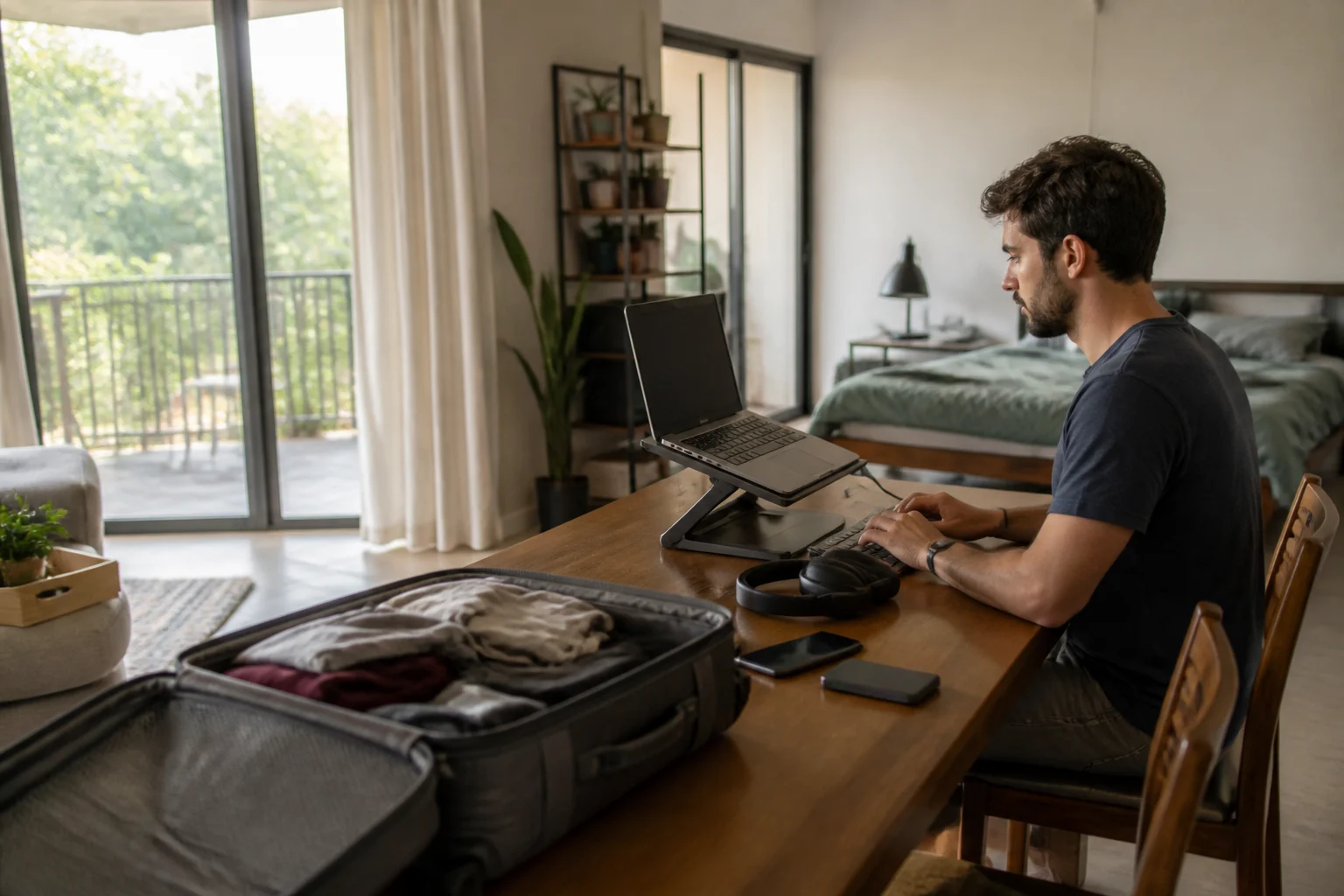
Slow travel — one to three months per base — beats fast travel for almost every working nomad: lower costs, better routines, real friendships and far less burnout. Fast travel only makes sense in short, deliberate bursts, not as a default way to live.
- Slow travel (1–3 months/base): cheaper rent, stable work, real routine, actual friends.
- Fast travel (days per city): higher costs, disrupted work, shallow connections, burnout risk.
- Fast travel fits short loops between longer stays, or scouting trips.
- Many nomads settle on 2–3 bases a year with short trips in between.
Why slow travel wins for working nomads
- Cost: monthly rents are far cheaper than nightly; you cook, you learn the cheap spots.
- Work: your setup and schedule stay consistent instead of resetting every few days.
- Routine: a gym, a coworking desk, a food default — all need a few weeks to stick.
- Friendships: they come from repeated contact, which fast travel makes impossible.
- You actually see the place instead of its top-10 list.
Fast travel can produce more destinations; slow travel creates the repetition needed for work, routine and relationships.
When fast travel actually fits

- A two-week regional loop between two longer stays.
- Scouting several cities before choosing a winter base.
- A specific event — a conference, a wedding, a festival.
- Visa-run travel where you're leaving a country briefly anyway.
- A short "reset" trip when you've been in one place too long.
Compare cost, internet, safety and weather so your slow-travel months are in the right cities.
Compare destinations →A sustainable rhythm
After a lot of trial and error, most long-term nomads I know land on something like: two or three main bases a year, one to four months each, with occasional two-week trips in the gaps. It keeps costs low, work stable and friendships alive, while still scratching the travel itch. See also the first-90-days timeline.
Field notes: what changes the outcome
Measure travel pace in disrupted workdays, not countries per month. Count packing, checkout, transit, arrival errands, internet testing and the concentration dip that follows. A two-hour flight can consume two productive days.
A realistic scenario
A fast itinerary can look cheaper because each booking is viewed separately. Add airport transport, meals in transit, early check-in gaps, unused coworking days and lost billable time, and the monthly total changes. A 28-night base can also unlock monthly housing and gym rates.
- Use a minimum 28-night stay during demanding client periods.
- Put moves after a delivery day, never before one.
- Keep one completely meeting-free arrival day.
- Do a weekly energy audit: sleep, deep-work hours, exercise and desire to explore.
- Travel faster only for a defined season, event or holiday—not as the permanent default.
True cost of a move
Count disruption, not only transport and accommodation.
Use it in three steps
Start Digital Nomad quick-reference card · editorial review: 31 August 2026.
Sources & further reading
Check figures and rules against the primary source before you act — they change. Last reviewed August 2026.
- Numbeo — crowd-sourced cost-of-living database
- OECD — research on remote work / teleworking
- Our World in Data — life satisfaction & wellbeing
- WHO — burn-out as an occupational phenomenon (ICD-11)
FAQ
Is slow travel or fast travel better for digital nomads?
Slow travel — one to three months per base — is better for almost every working nomad. It's cheaper, keeps work and routine stable, and lets friendships form. Fast travel suits short, deliberate trips, not everyday life.
How long should a digital nomad stay in one place?
One to three months is the sweet spot for most people: long enough for monthly rent, a routine and a social circle, short enough to keep travelling. Some go longer per base and take short trips between.
Why is fast travel bad for productivity?
Every move resets your workspace, schedule and routine, and eats a productive day or more in logistics. Doing that every few days leaves little stable time to actually work.
What's a sustainable travel rhythm for a working nomad?
Two or three main bases a year, one to four months each, with occasional two-week trips in between. It balances low costs and stable work with enough novelty.
About the author. I'm Alexandre. I've been running an online business from Southeast Asia, Europe and Latin America since I left a desk job, and I write the guides on Start Digital Nomad from wherever I'm based that month. This is what I actually use and do — not theory.