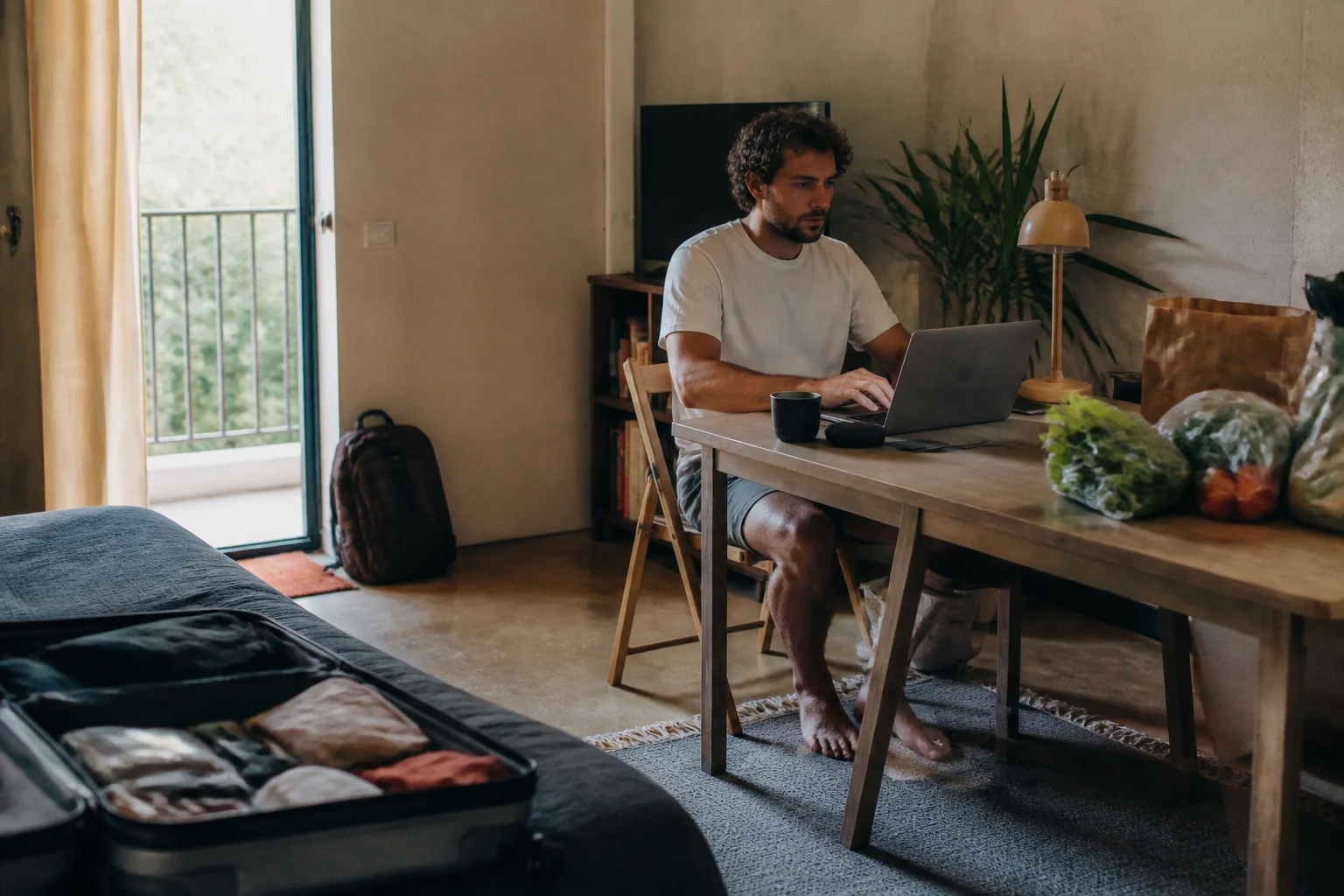
Monthly moves cost you a productive week unless you systematise them. A repeatable arrival checklist and a fixed weekly structure keep your output steady no matter which city you're in. The goal is to make the new place boring as fast as possible.
- Run the same arrival checklist every move: SIM, workspace, groceries, desk setup.
- Block deep-work mornings; batch calls into two afternoons.
- No sightseeing trips for the first two weeks — weekends only.
- Keep a routine that doesn't depend on a specific gym, cafe or city.
The arrival checklist
- Buy a data SIM/eSIM and test a video call — day one.
- Find and visit a workspace within 48 hours (coworking or a tested cafe).
- Do a grocery run and set up the kitchen for your normal breakfasts.
- Recreate your desk setup immediately — laptop stand, keyboard, mouse.
- Locate a gym or class and book the first session.
- Note the essentials: pharmacy, ATM, laundry, the fast route to your workspace.
I run the exact same six-item checklist every time I land. It turns a chaotic first week into a half-day of errands.
Protect the work week

- Deep-work mornings blocked before the city wakes up and messages start.
- Calls batched into two afternoons so the rest of the week stays open.
- Sightseeing on weekends only for the first fortnight — then loosen up.
- One "settle" buffer day right after arrival with no meetings.
- Async-first so nothing important depends on catching you live during a travel day.
Time zone, internet and coworking supply vary a lot. Compare cities before you plan the route.
Compare destinations →A routine that survives the move
- A morning sequence that needs no specific place — light, water, movement, plan the day. See portable morning routines.
- A bodyweight workout you know by heart, plus one paid gym/class per base.
- A food default you can hit anywhere (protein + veg; cook breakfast).
- Fixed shutdown ritual so work ends even when the day was disrupted.
- Travel slower if the monthly churn is still killing output — slow vs fast travel.
Field notes: what changes the outcome
Separate portable habits from location-dependent habits. A portable start ritual—water, task list, headphones, first 50-minute focus block—survives a bad desk or unfamiliar neighborhood. Protect it before adding gyms, cafes and social events.
A realistic scenario
The predictable arrival mistake is spending Monday morning discovering that the Wi-Fi fails under video load. Test a real call, upload a large file and run a phone-hotspot fallback on arrival. A speed-test number alone does not reveal packet loss, router congestion or a noisy room.
- Send hosts a screenshot request for download, upload and latency before booking.
- Carry a laptop stand, compact keyboard and one reliable headset.
- Choose three outcomes for arrival week and postpone optional admin.
- Map one backup workspace within walking distance.
- Use the final hour before departure to save files offline and confirm the next address.
48-hour arrival protocol
Remove uncertainty before asking your brain for peak output.
Use it in three steps
Start Digital Nomad quick-reference card · editorial review: 31 August 2026.
Sources & further reading
Check figures and rules against the primary source before you act — they change. Last reviewed August 2026.
- OECD — research on remote work / teleworking
- Harvard Business Review — time management & focus research
- Our World in Data — internet access & connectivity
FAQ
How do digital nomads stay productive while travelling?
They run a fixed arrival checklist every move (SIM, workspace, groceries, desk setup), block deep-work mornings, batch calls into two afternoons, keep sightseeing to weekends for the first two weeks, and maintain a routine that doesn't depend on a specific place.
How long does it take to get productive after moving cities?
With a repeatable arrival checklist, about half a day of errands plus one buffer day. Without a system, most nomads lose the better part of a week each move.
Should I sightsee when I first arrive in a new city?
Keep it to weekends for the first two weeks while you establish your workspace and routine, then loosen up. Front-loading tourism is the fastest way to lose a productive week.
What if changing cities monthly still wrecks my focus?
Travel slower. A base per month or longer dramatically reduces the setup tax and lets routines and friendships actually form.
About the author. I'm Alexandre. I've been running an online business from Southeast Asia, Europe and Latin America since I left a desk job, and I write the guides on Start Digital Nomad from wherever I'm based that month. This is what I actually use and do — not theory.