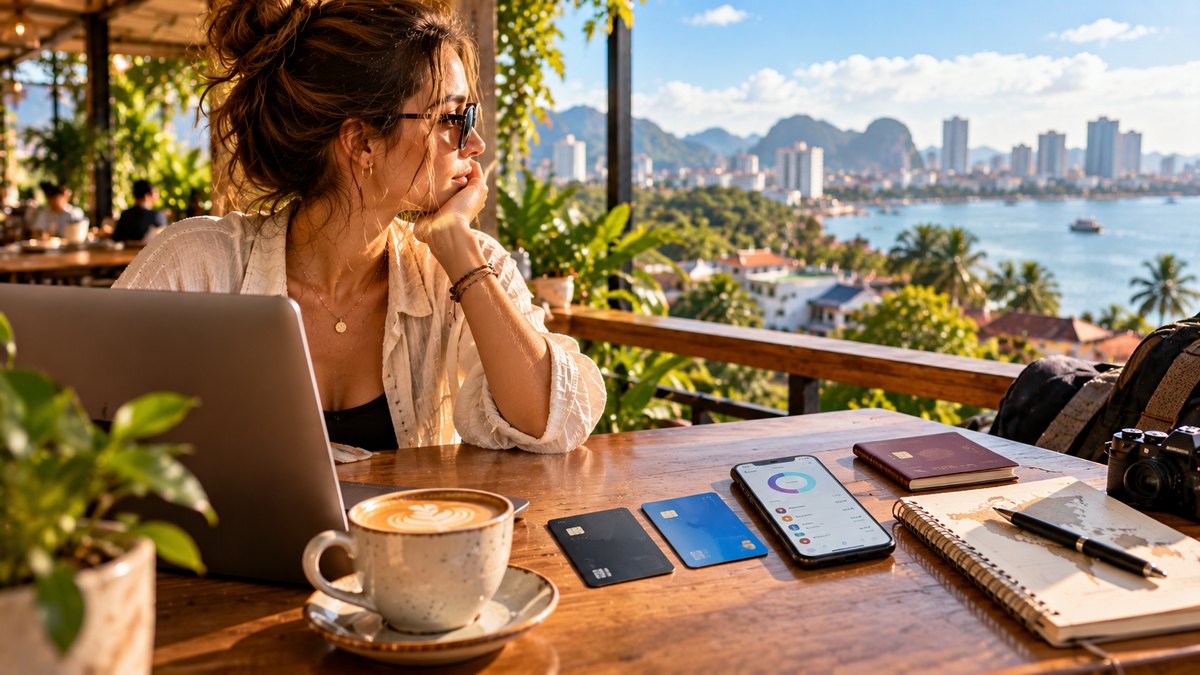
A solid digital nomad banking setup has three parts: a multi-currency account for day-to-day spending and getting paid, a home-country bank for income and official ties, and a backup card kept somewhere separate. Get those three in place before you leave and you'll avoid almost every money headache on the road.
- Layer 1: multi-currency account (Wise, Revolut) for spending and receiving in multiple currencies.
- Layer 2: a home-country bank for salary, official mail and credit history.
- Layer 3: a spare debit/credit card stored apart from your wallet.
- Carry a card with no foreign transaction fees and expect at least one card to be blocked abroad at some point.
The three-layer setup
- Multi-currency spending account — holds several currencies, gives you local bank details (USD, EUR, GBP, AUD...), near-interbank exchange rates, and a debit card you actually use day to day.
- Home-country bank account — where salary or client payments can land, where your credit history lives, and the address on file for tax and official letters. Don't close this.
- Backup card — a second debit or credit card from a different network, kept in your bag rather than your wallet, for when the primary is lost, skimmed or frozen.
The day a card gets frozen at 9pm in a country where the bank's phone line doesn't accept international calls, the backup card stops being optional.
Multi-currency spending accounts
- Wise — best exchange rates, local receiving details in many currencies, low transparent fees, widely accepted for freelance payouts. The default.
- Revolut — strong app, budgeting tools, tiered plans; weekend FX markups on the free plan, and support can be slow.
- Regional options where you have residency — N26 (EU), Nubank (Brazil/Mexico/Colombia), Monzo/Starling (UK).
Wise publishes its full fee schedule and receiving-account details in its help centre — read how balances are held and which currencies get local details before relying on it for income.
Which cards to carry
- One debit card with no foreign transaction fee (Wise, Revolut, or a fee-free home-bank card).
- One credit card for bookings and chargeback protection — ideally no FX fee and some travel insurance built in.
- One spare card on a different network (if your main is Visa, carry a Mastercard) kept separately.
- A small amount of USD or EUR cash for the "everything is down" scenario.
If you freelance, see my guide to receiving client payments abroad without losing a slice to fees every month.
How to get paid while traveling →Keeping a home-country bank
Don't close your home account when you leave. You need it for credit history, for services that reject fintech accounts, and often for tax. Keep a valid address on file (a family member's home, or a mail-forwarding service), keep a little activity on the account, and make sure you can pass its identity checks from abroad.
The problems nobody warns you about
- Fraud freezes when you log in from five countries in a month. Tell the bank your plans; keep a backup.
- Account closures once you lose your home address — especially with some fintechs.
- 2FA locked to a home SIM you no longer use. Move to an app authenticator and keep the old SIM active if you can.
- ATM and FX fees stacking up on the wrong card — a few percent on everything adds up fast.
- Deposit-insurance limits — know what's protected (e.g. the FDIC in the US) and don't park large balances in a lightly-regulated app.
Sources & official references
Always confirm rules and figures on the primary source before you act — these change often. Last reviewed August 2026.
- Wise — multi-currency account help centre
- Revolut — official fee schedule
- FDIC — US deposit insurance basics
- US CFPB — consumer guidance on bank accounts & cards
- UK FCA — consumer information on e-money & banking
FAQ
What is the best bank account for digital nomads?
Most nomads use Wise as the core multi-currency account for spending and receiving money, backed by a home-country bank for salary and official ties, plus a second card on a different network as a backup.
Should I close my home bank account when I become a digital nomad?
No. Keep it open for credit history, for services that reject fintech accounts, and for tax purposes. Maintain a valid address on file and enough activity to keep it in good standing.
How do I avoid foreign transaction fees while traveling?
Carry at least one debit card with no foreign transaction fee (such as Wise or Revolut), pay in the local currency rather than accepting "dynamic currency conversion", and use fee-free ATMs where possible.
Is it safe to keep all my money in Wise or Revolut?
They are regulated e-money institutions, but your balance is generally safeguarded rather than covered by full deposit insurance like a bank. Keep large reserves in a properly insured bank account and use the fintech account for working balances.
About the author. I'm Alexandre. I've been running an online business from Southeast Asia, Europe and Latin America since I left a desk job, and I write the guides on Start Digital Nomad from wherever I'm based that month. This is what I actually do — not theory — but I'm not a lawyer or a tax adviser, so treat the legal and tax sections as a starting point and confirm your own situation with a professional.