A micro-SaaS doesn't need a dozen features. It needs one recurring problem, a clear result and customers who care enough to come back. Before spending weeks on dashboards, here's how to test demand, calculate operating costs and ship a small product you can trust.
Quick answer: build the smallest useful result
Identify one user, one repeated problem and one measurable outcome. For example, a remote-work planner can filter five verified cities against a traveler's budget and have Claude explain tradeoffs. Validate the value with users before investing in an elaborate dashboard or multiple AI agents.
Step 1: conduct customer discovery
Interview at least five relevant people, asking about their last experience solving the problem, current alternatives, time spent and consequences of mistakes. Avoid leading questions such as 'Would you pay for our AI product?'. Seek a concrete pilot commitment rather than compliments on an idea.
Step 2: write a one-page MVP specification
- Target customer and the specific painful job.
- Single primary user action and expected output.
- What data enters and leaves the app.
- What is algorithmic versus language-model-generated.
- Hard non-goals to prevent feature sprawl.
- Acceptance tests, privacy checks and one value metric.
Step 3: choose a simple architecture
Use a lightweight responsive frontend, server-side API endpoint, authenticated database and an approved model provider such as Anthropic. The server checks inputs, permissions, rate limits and spend caps. Keep external credentials in protected configuration, never in browser source. If a rule can reliably filter price ranges, use code before using a model.
Step 4: separate evidence from generation
For the digital nomad planner example, maintain destination records with dated source URLs. A deterministic query creates a shortlist. The model receives only these verified records and writes a readable comparison. If visa, tax or cost data is missing, display 'verification required' instead of inventing numbers.
Step 5: estimate cost per successful task
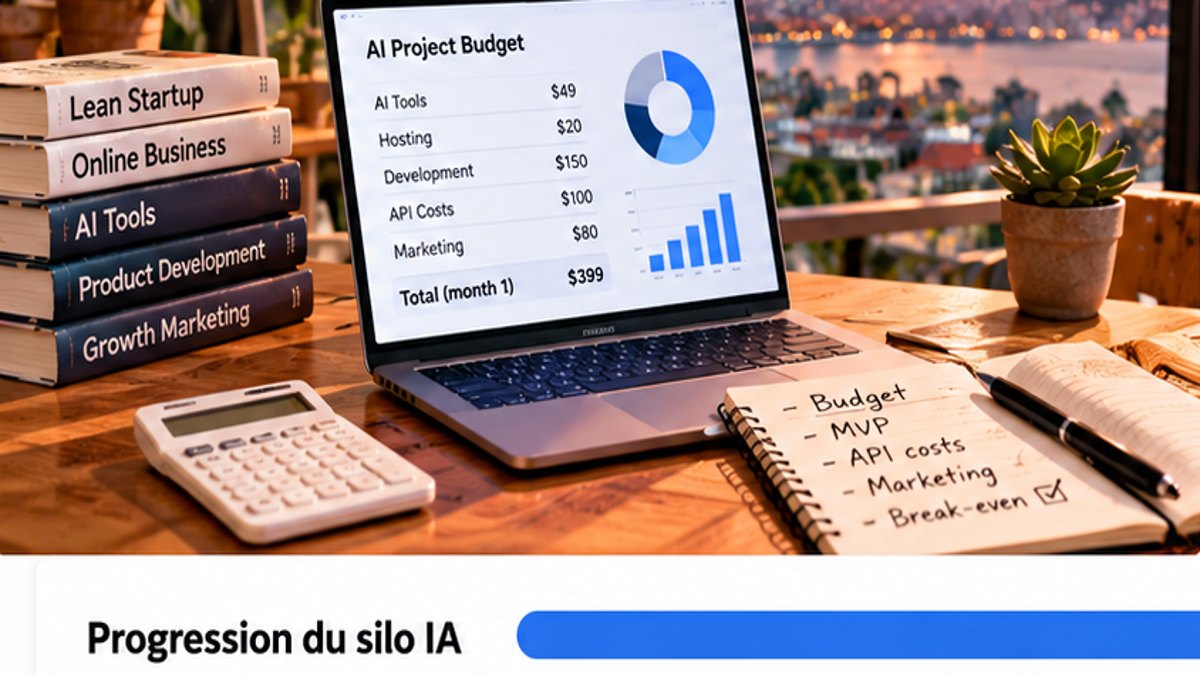
Suppose an average request uses 2,000 input tokens and 600 output tokens. At a hypothetical $2 per million input and $10 per million output, the model charge would be $0.004 plus $0.006 = $0.01 per request, before retries and other charges. These rates are illustrative, not an Anthropic quote. Check the live Claude pricing documentation. Add hosting, storage, payments, monitoring, support and acquisition to model real margins.
Step 6: build privacy and security boundaries
- Authenticate users and enforce authorization server-side.
- Apply quotas, input size limits, timeout handling and budget controls.
- Validate model output schemas and citations before displaying results.
- Minimize sensitive personal data in prompts and logs.
- Keep a review pathway for high-stakes recommendations.
- Back up data and plan incident recovery and key rotation.
Step 7: test before adding payments
Create a matrix of at least 20 realistic tasks including missing data, invalid inputs, malicious instruction attempts and provider outages. Record accuracy, latency, output validation failures, support burden and cost. If results are not reliably useful, improve the core feature before introducing paid plans.
Step 8: introduce pricing carefully
A free trial or limited free usage can help validation, but set request limits to prevent uncontrolled model charges. Choose a plan based on measured willingness to pay and estimated gross margins. Avoid unlimited plans until you can estimate worst-case consumption.
Step 9: launch with a transparent promise
The landing page should explain who it helps, show a real example, state what's verified versus generated, disclose limitations and make pricing understandable. Publish a privacy policy and terms appropriate to the business. Do not invent testimonials or imply a partner endorsement.
Step 10: measure retention rather than registrations alone
Track activation, first successful result, repeated usage, conversion, churn, cost per result and bug frequency. Interview customers who abandon the product. Useful retention is stronger evidence than a large but inactive sign-up list.
A four-week build plan
- Week 1: interviews, source records, user story and static prototype.
- Week 2: secure API integration, deterministic filtering and output validation.
- Week 3: user testing, edge cases, observability and privacy review.
- Week 4: limited beta, feedback, pricing experiment and iteration.
FAQ
Can I build an AI SaaS without a team?
A small scoped beta can be built by a solo founder with sufficient skills, but production security, maintenance and customer support remain substantial tasks.
Does a Claude subscription cover a public SaaS?
Use authorized API access for a public app and review API billing separately. Current subscriber credits, if applicable, have eligibility and limits.
Do I need investors?
Not necessarily for a lean prototype. Funding requirements depend on technical complexity, acquisition cost and operating margin.
Sources and related guides
Refer to Anthropic API overview, API pricing, Claude assistant tutorial, Claude startup program guide and AI solo business guide.
Continue learning: Browse the AI & Automation hub for all 30 tutorials and comparisons.